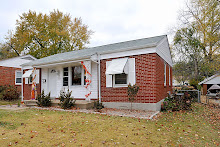
Both the Pitted Olive, and The Juniper Grill have closed their doors.
The Pitted Olive was a great little spot on Hampton in Saint Louis Hills, and The Juniper Grill was in Soulard. Both were fantastic restaurants, and the state of the economy has apparently taken its toll on them.
I am going to miss the Pitted Olive's Reuben!
Tuesday, December 2, 2008


Monday, December 1, 2008
Naming the Trains?
With the opening of the new downtown transportation center here and some planned rail and signal improvements across the state, Amtrak and the Missouri Department of Transportation are looking for some new names for the trains that run a couple of times a day between St. Louis and Kansas City. The trains are currently called "The Ann Rutledge" and the "Missouri Mules." The new name for the passenger train service will be selected in a multi-part statewide contest.
Can you think of some apt names? If so, you can submit them here.
Thursday, November 27, 2008
The Perfect Thanksgiving Getaway...
...or, the perfect vacation home.

Located on Hideaway Island in the Noosa region of Australia’s Sunshine Coast is this house designed by local architect Frank Macchia.
The 4 bedroom / 4 bathroom house is currently for sale, and the agents at Richardson & Wrench will be auctioning off the house on January 10th, 2009.
Check out the listing with Richardson & Wrench - here.
Wednesday, November 26, 2008
Who Wants to Convert A Firehouse?
As a teenager, I always thought it would be awesome to convert a firehouse into a single residence. Specifically, the house at Lansdowne and Donovan next to what is now LeGrand's Market. My lack of real estate knowledge prohibited me from realizing, at the time, that I wouldn't need over 10,000 square feet, but even today, I still think you could do some remarkable things in coverting an old firehouse into several residential units.

The old firehouse at 2000 Washington is up for sale. It's right next door to the Sporting News lofts and The Tudor Lofts, and other recent developments. Too bad I don't have $900,000 laying around...
So, who does? Let's start rehabbing!
Tuesday, November 25, 2008
Now is the Time!!!
If you have been thinking about making a move, or buying your first residence, it's time to get off the sidelines. Rates dropped like a rock today!
Conventional, 30-year Fixed rate: 5.25%
FHA, 30-year fixed rate: 5.50%
All of the past FHA closings I have had in the past few months have been in the 6.75% to 7% range. 5.50% for FHA is absolutely unheard of!
Now is the time!
Drop me a line if you are ready to make the move!
Great New Listing in Florissant!
Brand new to the market! This beautifully maintained 2BR/1BA home is nestled on a quiet block in beautiful Florissant. As you approach the home you are welcomed by the covered porch to enjoy the evenings.
 Once inside the sparkling hardwood will capture your attention and lead you through the living room & dining room, with beautiful custom paint and dazzling light fixtures.


 The huge kitchen located in the back of the home boasts sprakling new appliances and light fixtures.

 Down the hallway are the bedrooms, with fresh paint, sizable closets, and gorgeous hardwoods.


 The lower level is adorned with a huge bar that makes it the perfect spot to entertain. A lower level office, family room or additional bedroom would be perfect in the basement.


 This home is being offered at $109,900. If you or anyone you know is interested, be sure to contact me!
 Once inside the sparkling hardwood will capture your attention and lead you through the living room & dining room, with beautiful custom paint and dazzling light fixtures. The huge kitchen located in the back of the home boasts sprakling new appliances and light fixtures.

 Down the hallway are the bedrooms, with fresh paint, sizable closets, and gorgeous hardwoods.


 The lower level is adorned with a huge bar that makes it the perfect spot to entertain. A lower level office, family room or additional bedroom would be perfect in the basement.
Out back, a covered patio and permanent gas grill is perfect for lazy Sundays and backyard barbeques. Updated electric, plumbing, HVAC, siding, gutters, and soffits make this the perfect home to move right in and enjoy!
This home is being offered at $109,900. If you or anyone you know is interested, be sure to contact me! I'm Back!
Geez, what a fiasco that was. Blogger locked my account, as I was suspected of being a "spam blog." How their robots decided that, I have no idea, but the blog review process took far longer than it should have.
I am back and better than ever!
Tuesday, November 11, 2008
Absolutely Ridiculous
The Shady Oak theater - which has sat vacant since 2000, when it closed its doors - is being demolished. You know what's coming next...
It's being torn down so that a parking lot can take its place.
Far too many buildings that possess charm and character are demolished in our city - and cities everywhere. Surely this building could have been been adapted for re-use.
The irony of it all: one of the reasons Shady Oak closed was because of lack of parking...
Check out the Post-Dispatch article
Monday, November 10, 2008
For Sale: The Sliver House by Boyarsky Murphy
Want to spend $1.66 million and move to London? The Sliver House that Boyarsky Murphy designed and built in Maida Vale for Geoff MacCormack (who was once a backup singer for David Bowie) is up for sale.
Check it out at The Modern House Estate Agents.
Tuesday, November 4, 2008
I Need Your Help! Vote For Me!
I have been nominated for the St. Louis Post-Dispatch's Top Real Estate Professional. BUT, I need your help to win!
You can vote once EVERYDAY, online until 12-31-08, at: http://www.stltoday.com/homes
In the upper hand right corner, there's a graphic that says "Does Your Real Estate Agent Rock? Vote for the 2008 Reader's Choice Top Agent." You DO have to register on the site to vote, but it's quick, easy and painless. Please help support me and vote everyday if you can. As the winner, I get the recognition, as well as $7500 worth of advertising with the St. Louis Post-Dispatch!!!!!
I can't win without your help!! Vote Daily!!
I greatly appreciate it!
Monday, November 3, 2008
Federal Reserve Cut Has Little Benefit For Mortgages
From Matt McHugh at The Private Bank:
As we have seen all year, when the Federal Reserve cuts it's benchmark Fed Funds rate as it did this past Wednesday bringing that rate to just 1.0%, mortgage rates rose slightly. Contrary to consumer expectations, these two lending rates are technically unrelated, although Fed cuts do have a larger impact on the economy which will eventually affect mortgage rates, we just can't be certain what that impact will be. Over a longer term (say several months) mortgage rates should mirror changes to Fed Funds rate, so we have reason to believethat lower mortgage rates are in our future.
It is interesting to note that the last time Fed Funds was at 1.0% was June 2004. The 30 year fixed rate was around 5.5% and the 3 year ARM was just 4.0%.
A second factor also contributed to this week's rise in mortgage rates. The federal government's takeover of Fannie Mae and Freddie Mac in September left mortgage investors with the impression that there was explicit government backing of the debt and guarantees issued by Fannie and Freddie. Government officials have been sending mixed messages, however, raising some concern about whether the two companies really will have the long-term backing of the government. Due to the uncertainty, investors, particularly important foreign investors, have been reluctant to invest in Fannie and Freddie guaranteed mortgage backed securities. Yields required by mortgage backed security investors directly affect most mortgage rates. If the government were to unambiguously convince investors that it will stand behind Fannie and Freddie guarantees, then mortgage rates could be expected to move lower.
Friday, October 31, 2008
Going Green: Pesto Festo!

Buy your Tickets Now!$25 in advance, $30 at the door www.brownpapertickets.com/event/41757
November 8, 6:00pm-11:00pm
EarthDance is stirring up something fabulous (including pesto) for their November 8th kick-off event! Pesto Festo: A Harvest Celebration will include live music by The Buckhannon Brothers & The Grass Pack, a local foods feast prepared by several of St. Louis' best chefs, a silent auction featuring local art and eco goods, and an Inner Mission Productions film telling the story of the Mueller Farm. Caroline (and the late Al) Mueller will be honored at this event with a special tribute for keeping their family farm in organic production for over 60 years! Pesto Festo is hosted by EarthDance, The Open Space Council, and Live Well Ferguson, with all proceeds going to fund Freshman Farmies, an organic farming apprenticeship program that will be launched in 2009.
Tuesday, October 28, 2008
Easy Ways To Boost Your Credit
Ah yes, those 3 numbers that make up your credit score. Oh so important, especially in today's market.
Matt McHugh, of The Private Bank, had the following advice in his most recent newsletter:
A possible recession on top of a credit crunch means your credit score is more important than ever. It determines what you pay for any loan -- on a mortgage, car loan or credit card, and whether you get a job. "Buyer beware" when it comes to promisesof repairing your credit. Those commercials that offer free credit reports and free credit repair may sound tempting, but read the fine print. You can fix most of the blemishes on your credit report yourself relatively easily, said John Ulzheimer of Credit.com. Here are his top three ways to boost your score without a middleman:
1. If there is anything on your credit report that is legitimately incorrect, you can challenge it to have it removed within 30 days. (And remember, you can get a free copyof each of your three reports once a year from AnnualCreditReport.com)
2. Get your debt under control! Ulzheimer recommends this rule of thumb: reduce your debt to 10% of your credit limit and keep it below that amount.
3. Don’t use your credit report as a 10% off coupon at the mall. Meaning you shouldn’t apply for retail store specific credit cards that offer you a discount on your purchases at that store. They leave a “breadcrumb” in the form of a credit inquiry, which Ulzheimer said can lower your credit score for 12 months. Also, the interest rates on these cards are typically very high and the credit limits very low.
Monday, October 27, 2008
It's Not Impossible To Get A Mortgage...
Great article from the Washington Post:
"Despite market mess, it's not impossible to get a mortgage"
WASHINGTON - Credit squeeze, credit freeze, credit system seizures: Everybody knows how severe and painful the global financial breakdown has been - with banks unwilling to lend even to other banks.
But what about mortgages and real estate? Can you still get a home loan with less than a 20 percent or 30 percent down payment? Or with a credit score below 720? Absolutely. It would be a big stretch to label housing the sunny side of the market at the moment, but there's a lot more light there than in most other financial sectors. Consider these facts:
• There is no shortage of money available for home mortgages, no freezing of credit to purchase or refinance a house. Why? Because the American mortgage market effectively has been federalized - at least for the time being. More than 90 percent of new loans now are being made through the Federal Housing Administration insurance program, plus Fannie Mae and Freddie Mac. FHA is owned by the federal government, and Fannie and Freddie are operating under federal conservatorship. All three have unfettered access to global capital markets at rock-bottom costs because their borrowings are fully guaranteed by the Treasury. Ginnie Mae, which is FHA's pipeline to the bond market, recorded an all-time high of $29 billion in new mortgage-backed securities issued in August.
• Loan terms and credit underwriting standards have been toughened up, but you can still put down 3 percent (3.5 percent after Jan. 1) on an FHA-insured mortgage and 5 percent on certain Fannie Mae and Freddie Mac loan programs with private mortgage insurance. FHA's credit standards are generous and forgiving - the agency exists to help people with less-than-spotless credit histories. Fannie Mae and Freddie Mac have raised their credit score requirements over the past year, but buyers and refinancers with scores in the upper 600s can still qualify for loans carrying reasonable rates and fees.
• Despite the global financial system's quakes, mortgage rates not only remain low by historical standards but have actually declined recently. For the week ending Oct. 8, according to the Mortgage Bankers Association, average 30-year fixed rates dropped to 5.99 percent and 15-year mortgages averaged 5.71 percent. Freddie Mac said 30-year rates dropped to 5.94 percent.
• Maximum "jumbo" loan amounts through FHA, Fannie and Freddie in high-cost local markets on the West and East coasts continue to be $729,750 through December. In January, the high-cost maximum is projected to dip to approximately $625,000.
• Home prices - pushed by foreclosures and short sales - have rolled back to 2003 and 2004 levels or lower in many of the former boom markets. As a result, growing numbers of buyers are coming off the sidelines, making offers and writing contracts. The pending home sales index jumped by 7.4 percent based on purchase contracts signed in August, according to the National Association of Realtors. The heaviest increases - pointing to higher closed sales in the coming two to three months - were in California, Florida, Nevada and the Washington, D.C., metropolitan area.
Housing and mortgage leaders say consumer worries about the stock market have obscured positive developments under way in real estate, where pricing pain and downsizing have been facts of the life for the past two and a half years.
David G. Kittle, president and CEO of Principle Wholesale Lending Inc. and incoming chairman of the Mortgage Bankers Association, says "the mortgage market has never shut down" despite the global financial crisis. Money is "clearly available as long as you can qualify for it" with at least a modest down payment and decent credit history.
Matt Vernon, a national retail mortgage sales executive for Bank of America, said, "we've got more than enough liquidity" to handle mortgage demand. "We are open for business." Most of the bank's production is now funded through FHA, Fannie and Freddie.
On the front lines, mortgage company owner Jeff Lipes, president of Family Choice Mortgage near Hartford, Conn., says "I don't think consumers really know how free-flowing capital is right now in the residential mortgage market. There are no shortages, no breakdowns. People ought to be aware of that."
Bottom line: Scary as the news has been about stocks and banks, this is not the case for mortgages. Besides shopping at large national lenders, check in with local banks and credit unions who may be originating loans for their own portfolios - not for Fannie, Freddie or FHA. Many of them are healthy, have plenty of cash to lend, and may be surprisingly competitive on terms and rates compared with the big boys.
Thursday, October 23, 2008
First Time Home Buyer Tax Credit
Because I feel this is a great deal, I wanted to provide another posting regarding the bill that was passed:
Educate yourself. Read about the new first time home buyer tax credit for buying your new home.
1. Who is eligible to claim the $7,500 tax credit?
First time home buyers purchasing any kind of home—new or resale—are eligible for the tax credit. To qualify for the tax credit, a home purchase must occur on or after April 9, 2008 and before July 1, 2009. For the purposes of the tax credit, the purchase date is the date when closing occurs.
2. What is the definition of a first-time home buyer?
The law defines "first-time home buyer" as a buyer who has not owned a principal residence during the three-year period prior to the purchase. For married taxpayers, the law tests the homeownership history of both the home buyer and his/her spouse. For example, if you have not owned a home in the past three years but your spouse has owned a principal residence, neither you nor your spouse qualifies for the first-time home buyer tax credit. Ownership of a vacation home or rental property not used as a principal residence does not disqualify a buyer as a first-time home buyer.
3. How do I claim the tax credit?
Do I need to complete a form or application?Participating in the tax credit program is easy. You claim the tax credit on your federal income tax return. No other applications or forms are required. No pre-approval is necessary; however, prospective home buyers will want to be sure they qualify for the credit under the income limits and first-time home buyer tests.
4. Does the credit have to be paid back to the government? If so, what are the payback provisions?
Yes, the tax credit must be repaid. Home buyers will be required to repay the credit to the government, without interest, over 15 years or when they sell the house, if there is sufficient capital gain from the sale. For example, a home buyer claiming a $7,500 credit would repay the credit at $500 per year. The home owner does not have to begin making repayments on the credit until two years after the credit is claimed. So if the tax credit is claimed on the 2008 tax return, a $500 payment is not due until the 2010 tax return is filed. If the home owner sold the home, then the remaining credit amount would be due from the profit on the home sale. If there was insufficient profit, then the remaining credit payback would be forgiven.
5. Is there any way for a home buyer to access the money allocable to the credit sooner than waiting to file their 2008 tax return?
Yes. Prospective home buyers who believe they qualify for the tax credit are permitted to reduce their income tax withholding. Reducing tax withholding (up to the amount of the credit) will enable the future home buyer to accumulate cash by raising his/her take home pay. This money can then be applied to the down payment. Buyers should adjust their withholding amount on their W-4 via their employer or through their quarterly estimated tax payment. IRS Publication 919 contains rules and guidelines for income tax withholding. Prospective home buyers should note that if income tax withholding is reduced and the tax credit qualified purchase does not occur, then the individual would be liable for repayment to the IRS of income tax and possible interest charges and penalties.
6. What types of homes will qualify for the tax credit?Any home purchased by an eligible first-time home buyer will qualify for the credit, provided that the home will be used as a principal residence and the buyer has not owned a home in the previous three years. This includes single-family detached homes, attached homes like townhouses and condominiums, manufactured homes (also known as mobile homes) and houseboats.
7. Instead of buying a new home from a home builder, I have hired a contractor to construct a home on a lot that I already own. Do I still qualify for the tax credit?Yes. For the purposes of the home buyer tax credit, a principal residence that is constructed by the home owner is treated by the tax code as having been "purchased" on the date the owner first occupies the house. In this situation, the date of first occupancy must be on or after April 9, 2008 and before July 1, 2009.
In contrast, for newly-constructed homes bought from a home builder, eligibility for the tax credit is determined by the settlement date.
8. What is "modified adjusted gross income"?
Modified adjusted gross income or MAGI is defined by the IRS. To find it, a taxpayer must first determine "adjusted gross income" or AGI. AGI is total income for a year minus certain deductions (known as "adjustments" or "above-the-line deductions"), but before itemized deductions from Schedule A or personal exemptions are subtracted. On Forms 1040 and 1040A, AGI is the last number on page 1 and first number on page 2 of the form. For Form 1040-EZ, AGI appears on line 4 (as of 2007). Note that AGI includes all forms of income including wages, salaries, interest income, dividends and capital gains.
To determine modified adjusted gross income (MAGI), add to AGI certain amounts such as foreign income, foreign-housing deductions, student-loan deductions, IRA-contribution deductions and deductions for higher-education costs.
9. If my modified adjusted gross income (MAGI) is above the limit, do I qualify for any tax credit?
Possibly. It depends on your income. Partial credits of less than $7,500 are available for some taxpayers whose MAGI exceeds the phaseout limits. The credit becomes totally unavailable for individual taxpayers with a modified adjusted gross income of more than $95,000 and for married taxpayers filing joint returns with an AGI of more than $170,000.
10. Can you give me an example of how the partial tax credit is determined?
Just as an example, assume that a married couple has a modified adjusted gross income of $160,000. The applicable phase-out to qualify for the tax credit is $150,000, and the couple is $10,000 over this amount. Dividing $10,000 by $20,000 yields 0.5. When you subtract 0.5 from 1.0, the result is 0.5. To determine the amount of the partial first-time home buyer tax credit that is available to this couple, multiply $7,500 by 0.5. The result is $3,750.
Here’s another example: assume that an individual home buyer has a modified adjusted gross income of $88,000. The buyer’s income exceeds $75,000 by $13,000. Dividing $13,000 by $20,000 yields 0.65. When you subtract 0.65 from 1.0, the result is 0.35. Multiplying $7,500 by 0.35 shows that the buyer is eligible for a partial tax credit of $2,625.
Please remember that these examples are intended to provide a general idea of how the tax credit might be applied in different circumstances. You should always consult your tax advisor for information relating to your specific circumstances.
11. Does the credit amount differ based on tax filing status?
No. The credit is in general equal to $7,500 for a qualified home purchase, whether the home buyer files taxes as a single or married taxpayer. However, if a household files their taxes as "married filing separately" (in effect, filing two returns), then the credit of $7,500 is claimed as a $3,750 credit on each of the two returns.
12. Are there any circumstances for which buyers whose incomes are at or below the $75,000 limit for singles or the $150,000 limit for married taxpayers might not be able to claim the full $7,500 tax credit?
In general, the tax credit is equal to 10% of the qualified home purchase price, but the credit amount is capped or limited at $7,500. For most first-time home buyers, this means the credit will equal $7,500. For home buyers purchasing a home priced less than $75,000, the credit will equal 10% of the purchase price.
13. I heard that the tax credit is refundable. What does that mean?
The fact that the credit is refundable means that the home buyer credit can be claimed even if the taxpayer has little or no federal income tax liability to offset. Typically this involves the government sending the taxpayer a check for a portion or even all of the amount of the refundable tax credit.
For example, if a qualified home buyer expected, notwithstanding the tax credit, federal income tax liability of $5,000 and had tax withholding of $4,000 for the year, then without the tax credit the taxpayer would owe the IRS $1,000 on April 15th. Suppose now that taxpayer qualified for the $7,500 home buyer tax credit. As a result, the taxpayer would receive a check for $6,500 ($7,500 minus the $1,000 owed).
14. What is the difference between a tax credit and a tax deduction?A tax credit is a dollar-for-dollar reduction in what the taxpayer owes. That means that a taxpayer who owes $7,500 in income taxes and who receives a $7,500 tax credit would owe nothing to the IRS.
A tax deduction is subtracted from the amount of income that is taxed. Using the same example, assume the taxpayer is in the 15 percent tax bracket and owes $7,500 in income taxes. If the taxpayer receives a $7,500 deduction, the taxpayer’s tax liability would be reduced by $1,125 (15 percent of $7,500), or lowered from $7,500 to $6,375.
15. Can I claim the tax credit if I finance the purchase of my home under a mortgage revenue bond (MRB) program?
No. The tax credit cannot be combined with the MRB home buyer program.
16. I live in the District of Columbia. Can I claim both the DC first-time home buyer credit and this new credit?
No. You can claim only one.
17. I am not a U.S. citizen. Can I claim the tax credit?
Maybe. Anyone who is not a nonresident alien (as defined by the IRS), who has not owned a principal residence in the previous three years and who meets the income limits test may claim the tax credit for a qualified home purchase. The IRS provides a definition of "nonresident alien" in IRS Publication 519.
18. Why must the money be repaid?
Congress’s intent was to provide as large a financial resource as possible for home buyers in the year that they purchase a home. In addition to helping first-time home buyers, this will maximize the stimulus for the housing market and the economy, will help stabilize home prices, and will increase home sales. The repayment requirement reduces the effect on the Federal Treasury and assumes that home buyers will benefit from stabilized and, eventually, increasing future housing prices.
19. Because the money must be repaid, isn’t the first-time home buyer program really a zero-interest loan rather than a traditional tax credit?
Yes. Because the tax credit must be repaid, it operates like a zero-interest loan. Assuming an interest rate of 7%, that means the home owner saves up to $4,200 in interest payments over the 15-year repayment period. Compared to $7,500 financed through a 30-year mortgage with a 7% interest rate, the home buyer tax credit saves home buyers over $8,100 in interest payments. The program is called a tax credit because it operates through the tax code and is administered by the IRS. Also like a tax credit, it provides a reduction in tax liability in the year it is claimed.
20. If I’m qualified for the tax credit and buy a home in 2009, can I apply the tax credit against my 2008 tax return?
Yes. The law allows taxpayers to choose ("elect") to treat qualified home purchases in 2009 as if the purchase occurred on December 31, 2008. This means that the 2008 income limit (MAGI) applies and the election accelerates when the credit can be claimed (tax filing for 2008 returns instead of for 2009 returns). A benefit of this election is that a home buyer in 2009 will know their 2008 MAGI with certainty, thereby helping the buyer know whether the income limit will reduce their credit amount.
21. For a home purchase in 2009, can I choose whether to treat the purchase as occurring in 2008 or 2009, depending on in which year my credit amount is the largest?
Yes. If the applicable income phaseout would reduce your home buyer tax credit amount in 2009 and a larger credit would be available using the 2008 MAGI amounts, then you can choose the year that yields the largest credit amount.
Wednesday, October 22, 2008
Going Green: Better Life - Locally Produce Cleaning Products

Great new line of household cleaning products that are environmentally friendly. Locally made in St. Louis, and available at Local Harvest and Whole Foods.
From the Better Life website:
"We make Better Life green cleaning products because we want a better life. For our kids, pets, dads, moms, and especially Mom Earth. Our natural household cleaning products are safe on all surfaces. Especially the one we live on."
Tuesday, October 21, 2008
Absolutely Gorgeous House
Spylce contributed their design skills to the renovation and addition of a 1970’s house in Vancouver, Canada that produced this contemporary suburban home.
From Splyce:
From Splyce:
The existing main floor plan, which consisted of a maze of small, dark rooms and dead-ended corridors, was opened up to bring in natural light and create a flow and continuity to the space. Design decisions were heavily influenced on the existing landscape and the desire to physically and visually connect the interior spaces with the lush expanse of garden. To help facilitate this indoor/outdoor relationship, the new layout is organized around a distinct north-south axis with glazed doors at each end, offering not only views and access to the landscape, but effective cross ventilation when opened. Defined by new framed walls, the axis also serves to divide the main public and private functions of the home. Intimacy and light levels can be further manipulated by means of three 3′ x 8′ panels that slide the full length of the house along this line, allowing the user to close off or open up spaces as they wish. Clad with coloured steel sheets, these panels also serve as large magnet boards creating an ever-changing display of family postings and artwork.


Monday, October 20, 2008
The Wedge Set To Open Soon...
The Wedge, a rock and roll pizza bar which will serve pizzas designed by chef Blake Brokaw, and have live music in the upstairs performance space, The Iggy Ziggy Room, should be open any day. They were set to October 8th, but permits and licenses delayed the opening. It's located at the corner of Bates and Virginia.
It should be a great venue, and a perfect spot to saunter over to after a delicious meal at Iron Barley. I am certainly excited to check it out, as I drove delivery in high school for Virginia Auto Parts, which was located just a few blocks down Virginia. If I had a dollar for how many times I passed that intersection, or stopped in the 7-11 that is catty corner from the building, I wouldn't be typing this right now!
Sunday, October 19, 2008

Subscribe to:
Posts (Atom)